
Telehandler Suspended Loads Training - Lift Suspended Loads Safely with a Telehandler.
Need to lift, carry or position suspended loads with a telehandler?
Develop the additional lifting skills you need with practical NPORS training covering load charts, RCI systems, lifting capacity, stability, lifting accessories and safe suspended load handling.
Train at our Tewkesbury centre or arrange on-site training throughout the UK.
Training for Your Team: On suitable customer sites throughout the UK.
Booking for Yourself or Your Team?: At our Tewkesbury centre in Gloucestershire.
Call 01684 297167.
Enquire About Suspended Loads Training.
Telehandler Suspended Loads Training at a Glance
- Accreditation: NPORS Approved Training Provider
- Experienced: 1 Day
- Price: From £360 + VAT
- Novice: Up to 5 Days
- Group Size: Up to 4 Experienced / 3 Novice
- Location: Tewkesbury or On-Site Nationwide
Course Focus: Suspended Loads • Load Charts & RCI • Lifting Accessories • Stability & Safe Lifting
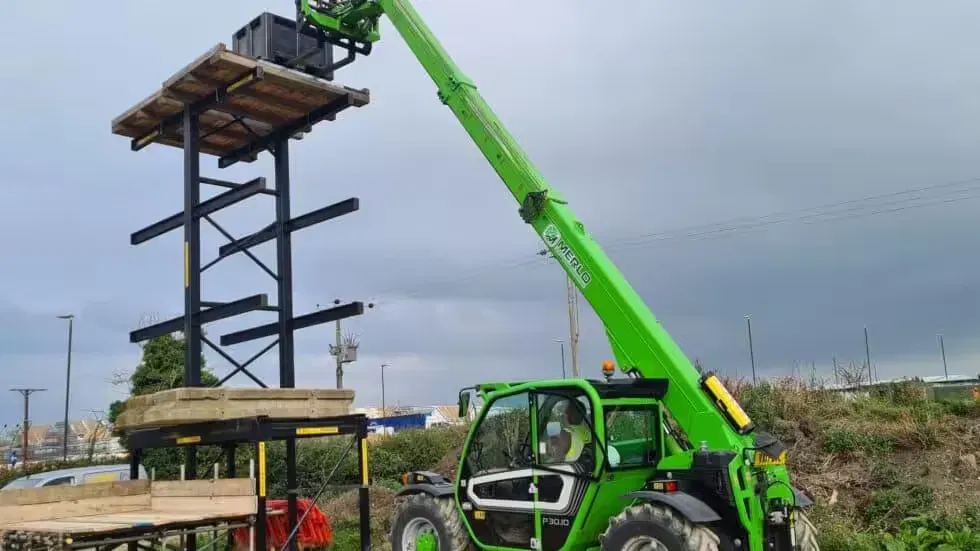
Do I Need Telehandler Suspended Loads Training?
If you normally use a telehandler with forks to pick up and place palletised loads but are now expected to lift freely suspended loads, you need to understand the additional risks and operating requirements involved.
Typical suspended loads can include:
- Pipes
- Beams
- Construction materials
- Plant components
- Equipment
- Bagged materials
- Loads attached using chains or slings
- Other loads suspended beneath an approved lifting attachment
A suspended load can swing and move independently of the telehandler.
This changes the way forces act on the machine and can significantly affect stability, capacity and control.
The operator must understand more than simply how to attach a load and raise the boom.
Which Telehandler Suspended Loads Course Do I Need?
Experienced Operator Training
The experienced route is intended for operators who already have good telehandler operating skills and need the additional knowledge and practical competence required for suspended load lifting operations.
You should already be confident with normal telehandler operation before moving into more specialised lifting work.
Novice Telehandler Suspended Loads Training
Novice training is available for candidates who require a more comprehensive training route.
The amount of training required depends on previous experience and existing telehandler competence.
If you're unsure which route you need, tell us what telehandler experience and certification you already have and the type of lifting work you are expected to carry out.
Why Choose Vally Plant Training?
Vally Plant Training provides practical plant operator and lifting operations training from our dedicated centre in Tewkesbury and on customer sites throughout the UK.
Our Telehandler Suspended Loads course concentrates on how lifting operations actually work on site rather than simply teaching enough information to pass an assessment.
Training includes:
- NPORS accredited training
- Experienced and novice routes
- Practical suspended load exercises
- Telehandler load chart training
- RCI and capacity awareness
- Machine stability
- Lifting accessories
- LOLER and PUWER awareness
- Lift planning awareness
- Working with a Slinger Signaller
- Centre-based training in Gloucestershire
- On-site training nationwide
- Individual and company bookings
Train with confidence
Practical skills for safe, competent operators
Choose the right machine category and route for your experience. Our team can discuss novice training, Experienced Worker Tests, refreshers and workplace delivery.
NPORS Telehandler suspended-load training is also included within the current CITB plant training standards eligible for grant where the relevant requirements are met.
What Is Telehandler Suspended Loads Training?
A telehandler is normally associated with picking up, transporting and placing loads using forks.
Using the machine with a suspended load is different.
Instead of the load being supported directly by the forks, the load is suspended beneath an appropriate lifting attachment using suitable lifting accessories.
Once suspended, the load can move, swing and react to changes in machine movement.
This introduces additional hazards that the operator needs to understand.
HSE guidance states that telehandler work should be properly planned, the risks assessed, and telehandlers should only be driven by authorised, trained and competent people who have completed appropriate training and testing.
What Will I Learn on the Telehandler Suspended Loads Course?
Training combines theoretical knowledge with practical lifting exercises.
Course content can include:
- Operator responsibilities
- Suspended load hazards
- Pre-use inspections
- Telehandler suitability
- Approved lifting attachments
- Lifting points
- Telehandler load charts
- Rated capacity
- Lifting radius
- Boom extension
- Boom angle
- RCI systems
- Machine stability
- Centre of gravity
- Load weight
- Load control
- Lifting accessories
- Slings, chains and shackles
- Safe working loads
- Working Load Limits
- Pre-lift checks
- Trial lifts
- Travelling with suspended loads
- Positioning and landing loads
- Communication
- Slinger Signaller duties
- Exclusion zones
- LOLER requirements
- PUWER requirements
- Lift plan awareness
- Emergency procedures
Telehandler Load Charts for Suspended Loads
A telehandler does not have one single lifting capacity that applies regardless of boom position.
The amount the machine can safely handle can change according to factors such as:
- Boom extension
- Boom angle
- Lifting height
- Forward reach
- Machine configuration
- Attachment fitted
- Load position
The operator therefore needs to use the correct load chart for the machine and attachment configuration being used.
A telehandler might be capable of handling a particular load close to the machine but not at greater reach.
HSE specifically notes that where a telehandler's safe working load depends on its configuration, the operator needs clearly visible information allowing the machine and load to remain within safe working limits for that configuration.
Why Lifting Radius Matters
As a load moves further away from the telehandler, the effect it has on the machine changes.
This is why lifting radius and forward reach are so important.
Extending the boom doesn't simply move the load further away.
It can considerably reduce the amount of weight the telehandler can safely handle.
Operators therefore need to understand the relationship between: load weight + boom position + lifting radius + machine capacity.
Never assume that because a telehandler can initially pick a load up, it can safely place that load at maximum reach.
The load chart must be checked.
What Is the RCI on a Telehandler?
An RCI – Rated Capacity Indicator is an important safety system on many telehandlers.
Depending on the machine, the system can provide information or warnings as the telehandler approaches its rated capacity.
Operators need to understand the system fitted to the particular machine they are using, including warning indicators and what action should be taken when a warning occurs.
The RCI should be treated as a safety aid.
It does not replace the load chart, correct planning or the operator's responsibility to work within the manufacturer's limits.
Telehandler Stability When Lifting Suspended Loads
Telehandler stability becomes particularly important when lifting a freely suspended load.
Unlike a load supported directly on forks, a suspended load can move independently from the machine.
Swing can be introduced by:
- Accelerating
- Braking
- Steering
- Travelling too quickly
- Sudden control movements
- Wind
- Uneven ground
- Changes in boom position
That movement can introduce additional forces into the telehandler.
Operators need to use smooth, controlled movements and understand how the position of the load affects the machine.
Ground Conditions and Telehandler Stability
A load chart assumes the machine is being operated within the conditions and configuration specified by the manufacturer.
Poor ground can undermine that.
Before lifting, consideration should be given to:
- Ground bearing capacity
- Soft ground
- Uneven surfaces
- Slopes
- Excavations
- Trenches
- Voids
- Underground services
- Recently backfilled ground
- Nearby structures
A telehandler carrying a suspended load needs a suitable operating area and sufficient space to complete the planned movement safely.
Travelling with a Suspended Load
Travelling introduces another set of risks because both the telehandler and suspended load are moving.
The operator needs to maintain control and avoid unnecessary load swing.
Sudden acceleration, braking or steering can cause the load to move.
The route should therefore be considered before travelling starts.
Operators need to consider pedestrians, other plant, ground conditions, overhead hazards, restricted areas and the space required for the telehandler and load.
What Is a Trial Lift?
A trial lift can be used to confirm that the load is secure, balanced and behaving as expected before continuing with the lifting operation.
The initial movement should be controlled.
This gives the lifting team an opportunity to identify problems before the load is raised or moved further.
If the load isn't secure or stable, the operation should be stopped and corrected rather than continuing in the hope that it will settle once it is moving.
Lifting Accessories for Telehandlers
Suspended load operations can involve lifting accessories such as:
- Chain slings
- Web slings
- Wire rope slings
- Shackles
- Hooks
- Lifting beams
- Other approved accessories
The equipment used needs to be suitable for the load and lifting operation.
Operators should understand identification markings, Working Load Limits and the importance of pre-use inspection.
Damaged, unidentified or unsuitable lifting accessories should not simply be used because they happen to be available.
HSE guidance requires lifting equipment to be of adequate strength and stability and appropriately marked; lifting accessories are also subject to relevant lifting-equipment requirements.
Telehandler Lifting Attachments
A telehandler should only be used with suitable attachments approved for the machine and intended operation.
Changing the attachment can change the machine's lifting characteristics.
The operator therefore needs to establish that the correct load chart and machine configuration are being used.
An attachment should never be fitted and treated as though the telehandler still has exactly the same lifting characteristics as it did with standard forks.
LOLER and Telehandler Suspended Loads
The Lifting Operations and Lifting Equipment Regulations 1998 (LOLER) are particularly relevant when telehandlers are used for lifting operations.
LOLER requires lifting operations involving lifting equipment to be:
- Properly planned by a competent person
- Appropriately supervised
- Carried out safely
It also places requirements around the suitability, strength, stability, marking and thorough examination of lifting equipment.
Training an operator is therefore important, but operator training on its own does not make the entire lifting operation LOLER compliant.
The lift itself still needs to be properly planned, supervised as appropriate and carried out safely.
PUWER and Telehandler Lifting Operations
Telehandlers are also work equipment, so the Provision and Use of Work Equipment Regulations 1998 (PUWER) are relevant.
LOLER works alongside the broader requirements of PUWER.
HSE specifically explains that lifting equipment is generally also work equipment and therefore PUWER requirements, including those concerning inspection and maintenance, will normally apply.
In practical terms, the telehandler should be suitable for the work, properly maintained and used by people with the appropriate training and competence.
HSE Requirements for Lifting Suspended Loads
HSE guidance is clear that lifting operations involving lifting equipment need to be properly planned by a competent person, appropriately supervised and carried out safely.
Planning should consider the risks involved, the equipment being used, the load, the environment and the people required to complete the operation.
For suspended-load work this can include:
- Telehandler suitability
- Load weight
- Load characteristics
- Machine capacity
- Load chart
- Attachment
- Lifting accessories
- Ground conditions
- Travel route
- Exclusion zones
- Communication
- Personnel
- Weather conditions
- Nearby structures
- Overhead hazards
- Positioning and landing the load
The complexity of the lift plan should be proportionate to the complexity and risk of the lifting operation.
Thorough Examination and LOLER Certification
Telehandlers used as lifting equipment are subject to LOLER thorough examination requirements.
Relevant lifting accessories also need to meet the applicable examination requirements.
HSE guidance specifically identifies telehandlers as lifting equipment requiring thorough examination by a competent person.
Operators should understand what documentation needs to be available and what to do if equipment is outside the required examination period or a defect has been identified.
Working with a Slinger Signaller
The telehandler operator may be only one member of the lifting team.
A Slinger Signaller may be responsible for duties such as selecting and attaching suitable lifting accessories and communicating with the operator during the lifting operation.
Clear communication is essential.
Before lifting starts, everyone involved should understand:
- Who is controlling the lift
- What signals will be used
- Where people will stand
- The planned movement
- Where the load will be landed
- What happens if communication is lost
If the operator loses sight of the designated signaller or doesn't understand the instruction being given, the operation should stop until safe communication has been restored.
Suspended Loads and Exclusion Zones
People should be kept away from suspended loads wherever reasonably practicable.
HSE guidance says loads should not be suspended over occupied areas where this can be avoided.
Where a load remains suspended for significant periods, the area beneath it should be treated as a danger zone with restricted access.
A suitable exclusion zone helps protect people from hazards associated with load movement, falling objects and unexpected equipment movement.
Can Anyone Sling a Load for a Telehandler?
The people involved in a lifting operation need to be competent for the duties they perform.
Being trained to operate a telehandler doesn't automatically mean someone is competent to carry out every other lifting role.
Where an operator is also expected to select lifting accessories, sling loads or perform signalling duties, the employer should ensure that person has the necessary knowledge, training and competence for those duties.
How Is Telehandler Suspended Loads Training Assessed?
Candidates need to demonstrate both knowledge and practical ability.
Assessment can include understanding the additional hazards associated with suspended loads and demonstrating safe practical lifting techniques.
Candidates should be able to demonstrate appropriate use of:
- Load charts
- Machine capacity information
- RCI systems
- Lifting attachments
- Lifting accessories
- Pre-lift checks
- Communication
- Load control
- Safe positioning
- Lifting and landing procedures
The candidate needs to demonstrate that they understand why the machine remains within its safe operating limits rather than simply following a memorised sequence.
NPORS Telehandler Suspended Loads Certification
Successful candidates completing the appropriate training and assessment can receive the applicable NPORS Telehandler Suspended Loads certification.
This provides evidence of the additional training and assessment completed for operating a telehandler with suspended loads.
If you already hold an NPORS Telehandler qualification, let us know when booking so we can establish the correct route.
CITB Funding for Telehandler Suspended Loads Training
Eligible employers may be able to claim CITB grant funding for qualifying Telehandler Suspended Loads Training.
The current 2026 CITB plant training list includes Telescopic Handler: Suspended Loads within the new plant training standards, with novice and experienced routes listed as eligible for grant subject to the applicable requirements.
Vally Plant Training is a CITB Training Provider Network Member.
On-Site Telehandler Suspended Loads Training
We provide on-site Telehandler Suspended Loads Training throughout the UK for companies with suitable equipment and facilities.
Training at your workplace can be particularly useful where operators will regularly use a particular telehandler, attachment and lifting equipment.
It also allows several employees to be trained without travelling to our Gloucestershire training centre.
On-Site Training Requirements
For on-site suspended-load training, suitable arrangements will normally need to include:
- Suitable telehandler
- Manufacturer's operator manual
- Correct load chart
- Approved lifting attachment
- Suitable lifting accessories
- Current thorough examination documentation where applicable
- Suitable loads for practical exercises
- Lift plan or lifting information where required
- Risk assessment and method statement
- Safe practical training area
- Suitable PPE
- Candidate photo ID
We can confirm the exact requirements before attending your site.
Telehandler Suspended Loads Training Near Me – Tewkesbury, Gloucestershire
Looking for Telehandler Suspended Loads Training near you?
Our dedicated plant training centre is based in Tewkesbury, Gloucestershire, with convenient access from Gloucester, Cheltenham, Worcester, Evesham and the surrounding areas.
We are close to Junction 9 of the M5, making the centre accessible from Gloucestershire, Worcestershire, the Midlands and South West.
For employers further afield, we provide on-site Telehandler Suspended Load Training nationwide.
Related Training Courses
Core NPORS Telehandler Training (N138) for novice operators, experienced operators and candidates requiring refresher training.
Training for people responsible for attaching loads and communicating with plant or lifting equipment operators.
Training for people responsible for supervising lifting operations and ensuring the lift is carried out in accordance with the planned safe system of work.
Training for people responsible for planning lifting operations.
Specialist training for excavator operators who need to use an excavator to lift suspended loads.
Book NPORS Telehandler Suspended Loads Training
Need to add suspended loads to your telehandler operating skills?
Vally Plant Training provides practical NPORS Telehandler Suspended Loads Training covering the additional knowledge and operating skills needed for lifting operations, including load charts, RCI systems, stability, lifting accessories, load control, LOLER and safe lifting procedures.
Novice & Experienced Training Routes Tewkesbury Training Centre On-Site Training Nationwide Individual & Company Bookings CITB Funding May Be Available Tell us what telehandler experience and certification you already have and what lifting operations you need to carry out.
We'll help you establish the appropriate training route.
About Vally Plant Training
Vally Plant Training is a family-run plant training provider based in Tewkesbury, Gloucestershire.
Established in 2014, we provide practical plant operator training, lifting operations training, Experienced Worker Tests, refresher courses and Plant Operations NVQ assessment for individuals, contractors and employers.
We are an NPORS Accredited Training Provider and CITB Training Provider Network Member, delivering training at our dedicated Tewkesbury plant training centre and on suitable customer sites throughout the UK.