
Slinger Signaller Training - Safer Lifting Operations. Confident, Trained Slinger Signallers.
Need Slinger Signaller Training for yourself or your team?
Vally Plant Training provides practical NPORS training for novice candidates, experienced workers and existing personnel requiring refresher training.
Train at our Tewkesbury centre or arrange training on a suitable customer site anywhere in the UK.
Training for Your Team: Delivered on suitable customer sites throughout the UK.
Booking for Yourself or your team?: Train at our Tewkesbury centre in Gloucestershire.
Call 01684 297167.
Enquire About Slinger Training.
Our Slinger Signaller course teaches candidates how to select and inspect lifting accessories, sling loads correctly, understand load weight and centre of gravity, recognise the effects of sling angles, use approved hand signals, communicate effectively with lifting equipment operators and control suspended loads safely.
Whether you are completely new to slinging operations, need to refresh existing skills or are an experienced slinger looking to gain an NPORS Slinger Signaller ticket (N402), we provide Novice, Refresher and Experienced Worker Test (EWT) routes to suit your experience.
NPORS Slinger Signaller Training at a Glance
NPORS N402 course routes, training duration, prices and certification options
- Accreditation: NPORS Accredited Training Provider
- Category: N402 Slinger Signaller Training
- Novice Price: From £895 + VAT
- Experienced Duration: 2-3 Hours • Maximum 6 Candidates
- Experienced Test Price: From £320 + VAT
- Location: Tewkesbury or On-Site Nationwide
Course Focus: Safe Slinging • Lifting Accessories • WLL • Sling Angles • Load Control • Hand Signals Slinger Training for Businesses: Published prices apply to training and testing at our Tewkesbury centre.
On-site Slinger Signaller training is quoted separately based on location, candidate numbers and the training required.
Discounts may be available for multiple operators or combined plant and lifting training bookings.
Which Slinger Signaller Course Do I Need?
The right Slinger Signaller course depends on your current experience.
Vally Plant Training offers three routes: Novice Training, Experienced Worker Testing and Refresher Training.
Choosing the correct route ensures you receive the right level of training or assessment rather than simply booking the shortest course.
Novice Slinger Signaller Training
Our 2-day Novice Slinger Signaller Course is for candidates with little or no previous slinging and signalling experience.
Training develops the knowledge and practical skills required to work safely as a Slinger Signaller, including selecting and inspecting lifting accessories, understanding Working Load Limits (WLL), assessing load weight and centre of gravity, applying safe slinging techniques, understanding sling angles, controlling suspended loads and communicating with lifting equipment operators using recognised signals.
Duration: 2 days.
Maximum candidates: 3.
Price: From £895 + VAT
Experienced Worker Test – NPORS N402
Already working as a Slinger Signaller and confident carrying out lifting operations without instruction?
The NPORS N402 Experienced Worker Test (EWT) is designed for experienced candidates who already have the knowledge and practical ability required to meet the NPORS assessment standard.
This is an assessment route, not a shortened training course.
Candidates should already be competent in selecting lifting accessories, slinging different loads, understanding WLL and sling angles, controlling loads and communicating safely throughout lifting operations.
Duration: 2-3 Hours.
Maximum candidates: 6.
Price: From £320 + VAT
Slinger Signaller Refresher Training
Refresher Slinger Signaller Training is intended for previously trained operators who need to refresh their knowledge and practical skills or whose employer requires updated training.
Candidates should hold suitable recognised previous certification or be able to demonstrate appropriate previous training and experience.
The refresher course revisits key areas including lifting accessories, sling selection, WLL, load control, communication, hand signals and safe lifting procedures.
Can I Do a Slinger Signaller Course in One Day?
Yes.
Suitable experienced Slinger Signallers can complete the NPORS Experienced Worker Test in one day.
This route is designed for candidates who already have enough practical experience to demonstrate competence without being taught how to carry out the role.
An experienced candidate should already understand:
Train with confidence
Practical skills for safe, competent operators
Choose the right machine category and route for your experience. Our team can discuss novice training, Experienced Worker Tests, refreshers and workplace delivery.
- Selecting lifting accessories
- Working Load Limits
- Sling configurations
- Sling angles
- Load weight and centre of gravity
- Suitable lifting points
- Pre-use checks
- Attaching and detaching loads
- Suspended-load control
- Exclusion zones
- Recognised hand signals
- Communication with the operator
- Safe landing of loads
If you still need instruction in these areas, the novice Slinger Signaller course is the correct route.
Why Choose Vally Plant Training for Slinger Signaller Training?
Choosing the right training provider matters, particularly for a safety-critical role within lifting operations.
Vally Plant Training delivers practical NPORS N402 Slinger Signaller Training focused on developing genuine workplace competence, not simply getting candidates through a test.
NPORS Accredited Training Provider: Training and assessment delivered directly by experienced instructors for recognised NPORS certification.
Practical Lifting Experience: Candidates work with real loads and lifting accessories, developing the practical skills required to sling, signal and control loads safely.
Novice & Experienced Operator Routes: Choose from structured novice training, refresher training or an Experienced Worker Test depending on your existing knowledge and experience.
Dedicated Tewkesbury Training Centre: Individuals can train at our Gloucestershire centre with the equipment and facilities required for practical Slinger Signaller training and assessment.
Nationwide On-Site Training: Employers can arrange training at their own premises or site where suitable lifting equipment, accessories and training conditions are available.
CITB Training Provider Network Member: Vally Plant Training is a CITB Training Provider Network (TPN) member and can support eligible employers with applicable training arrangements.
Direct Training Provider: You book directly with Vally Plant Training.
We are a family-run training provider established in 2014 — not a training broker passing your booking to another company.
Training Beyond the Card: Our focus is on ensuring candidates understand the responsibilities behind safe lifting operations, including accessory selection, WLL, sling angles, centre of gravity, communication and load control.
Need to book Slinger Signaller Training?
Call 01684 297167 or email info@vallyplanttraining.co.uk to discuss course dates, candidate numbers and the right training route.
What Is Slinger Signaller Training?
Slinger Signaller Training teaches candidates how to safely prepare loads for lifting and communicate with the operator controlling the lifting equipment.
The role combines two functions.
The slinger selects and uses suitable lifting accessories to attach the load correctly.
The signaller communicates with the lifting equipment operator using recognised hand signals, radio communication or other agreed methods.
In many workplaces, these duties are carried out by the same competent person.
A trained Slinger Signaller may work with:
- Mobile cranes
- Tower cranes
- Excavators used for lifting
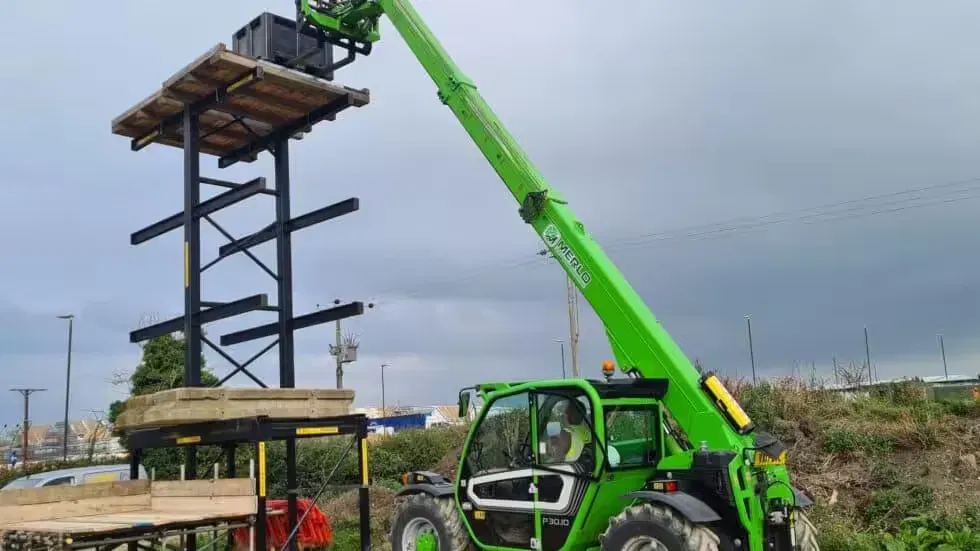
- Telehandlers lifting suspended loads
- Lorry loaders
- Other suitable lifting equipment
Who Should Attend Slinger Signaller Training?
This course is suitable for people expected to:
- Sling loads
- Select lifting accessories
- Attach and detach loads
- Signal lifting equipment operators
- Control suspended loads
- Work with cranes
- Work with excavators used for lifting
- Work with telehandlers handling suspended loads
- Assist with lifting operations
- Work as part of a lifting team
Slinger Signaller Training is commonly required across construction, groundworks, civil engineering, utilities, infrastructure, steelwork, manufacturing, logistics and other industries involving lifting operations.
What Does Slinger Signaller Training Cover?
The NPORS N402 Slinger Signaller course develops the knowledge and practical skills needed to prepare, attach, direct and control loads safely during lifting operations.
Candidates are trained to understand not only how to sling a load, but why the choice of lifting accessories, sling configuration, load characteristics and communication method can affect the safety of the entire lift.
Course content includes:
- Slinger Signaller responsibilities within a lifting operation
- Relevant lifting legislation and safe working practices
- Identifying different types of lifting accessories
- Pre-use inspection of chains, slings, shackles and other lifting accessories
- Understanding Working Load Limits (WLL)
- Identifying load weight and assessing centre of gravity
- Selecting suitable lifting accessories for the load
- Understanding how sling angles affect loading and capacity
- Correct slinging and attachment techniques
- Safe positioning before lifting begins
- Establishing and maintaining exclusion zones
- Recognised Slinger Signaller hand signals
- Effective communication with crane and plant operators
- Controlling suspended loads safely
- Use of tag lines where appropriate
- Identifying hazards during lifting operations
- Landing, positioning and releasing loads safely
- Practical slinging and signalling exercises
- Preparing for the NPORS theory and practical assessment
The course places strong emphasis on practical decision-making.
A competent Slinger Signaller must be able to recognise when a lifting arrangement is unsafe, select the correct equipment for the task and maintain clear communication with the operator throughout the lift.
Understanding Loads, WLL, Sling Angles & Centre of Gravity
Safe slinging starts before the load leaves the ground.
A Slinger Signaller must be able to assess the load, select suitable lifting accessories and recognise factors that could make the lifting arrangement unstable or unsafe.
Working Load Limits (WLL)
Every lifting accessory has a Working Load Limit (WLL) that must not be exceeded.
The Slinger Signaller needs to identify the capacity of chains, slings, shackles and other lifting accessories and ensure they are suitable for the load and lifting configuration being used.
The capacity of a lifting arrangement can change depending on how the accessories are configured, so selecting equipment purely because an individual sling appears capable of carrying the load is not enough.
Sling Angles
Sling angle has a major effect on the forces within a lifting arrangement.
As the angle changes, the tension imposed on the sling legs can increase significantly.
Candidates learn why sling configuration and angle must be considered when selecting lifting accessories and why an apparently simple change to the way a load is slung can affect whether the lift remains within safe limits.
Load Weight & Centre of Gravity
Before lifting, the Slinger Signaller needs to understand the weight of the load and the position of its centre of gravity.
Incorrectly assessing the centre of gravity can cause a load to tilt, rotate or become unstable as it is raised.
Suitable lifting points and sling positions must therefore be selected so the load remains controlled throughout the lifting operation.
Inspecting Lifting Accessories
Chains, slings, shackles and other lifting accessories must be suitable for the intended lift and checked before use.
Candidates learn how to identify common defects, damage, excessive wear and other conditions that could make lifting equipment unsafe.
Lifting accessories are also subject to the requirements of LOLER, including appropriate thorough examination arrangements.
Equipment that is defective, unsuitable or outside the required examination arrangements must not simply be used because it is available on site.
Communication & Load Control
Clear communication between the Slinger Signaller and lifting equipment operator is essential.
Candidates learn recognised hand signals and how to maintain effective communication during lifting, travelling, positioning and landing operations.
The Slinger Signaller must also maintain awareness of personnel, exclusion zones, obstructions and changing conditions around the lift.
If communication is lost or the operation becomes unsafe, the lift should be stopped until it can continue safely.
PPE for Slinger Signaller Training
Candidates should arrive with suitable PPE for practical lifting operations.
As a minimum, this will normally include:
- Safety boots ✓ High-visibility clothing ✓ Safety helmet ✓ Suitable work gloves ✓ Eye protection where required ✓ Suitable workwear for the training environment
Additional PPE may be required depending on the site, lifting equipment and working environment.
Candidates attending training on a customer site must also comply with the site's PPE requirements.
LOLER and Slinger Signaller Duties
The Lifting Operations and Lifting Equipment Regulations 1998 (LOLER) apply to lifting operations and lifting equipment used at work.
LOLER requires lifting operations to be properly planned, appropriately supervised and carried out safely.
A competent Slinger Signaller forms an important part of the lifting team, but Slinger Signaller Training does not replace the need for proper lift planning and supervision.
Thorough Examination of Lifting Accessories
Lifting accessories used at work can be subject to LOLER thorough examination requirements.
A pre-use inspection does not replace a statutory thorough examination.
Likewise, having evidence of a thorough examination does not remove the need for the user to check the accessory before use.
What Is a Trial Lift?
A trial lift involves raising the load only enough to confirm that it is secure, balanced and behaving as expected.
The lifting team can check:
- Load balance
- Sling position
- Lifting points
- Security
- Accessory behaviour
- Unexpected movement
- Communication
If something is wrong, the load can be lowered and the arrangement corrected before continuing.
Slinger Signaller Hand Signals
Clear communication between the Slinger Signaller and lifting equipment operator is essential.
Recognised signals can be used for instructions including:
- Hoist
- Lower
- Stop
- Emergency stop
- Slew
- Travel
- Direction of movement
The operator should know who is providing the signals before the lift starts.
If communication is lost or an instruction is unclear, the safe response is to stop until effective communication is restored.
Radio Communication
Some lifting operations require radio communication because the lifting equipment operator cannot maintain direct visual contact with the Slinger Signaller.
The method of communication should be agreed before lifting begins.
Instructions should be clear, concise and understood by everyone involved.
The team should also know what happens if radio communication is lost.
Exclusion Zones and Suspended Loads
People should be kept clear of suspended loads wherever reasonably practicable.
The lifting area should prevent people entering positions where they could be struck or trapped by:
- The load
- Lifting accessories
- The lifting machine
- Moving components
A Slinger Signaller should maintain a safe position while still being able to control and communicate during the lifting operation.
Slinger Signaller vs Banksman
These terms are often confused.
A Slinger Signaller is primarily involved with lifting operations, including attaching and controlling loads and communicating with the lifting equipment operator.
A Vehicle Banksman normally controls vehicle movements, while a Plant Banksman may help control mobile plant movements.
These are not automatically interchangeable roles.
If your job involves slinging and controlling suspended loads, Slinger Signaller Training is normally the relevant course.
Slinger Signaller vs Lift Supervisor
The Slinger Signaller works directly with the load and lifting equipment.
Slinger Signaller vs Appointed Person
The Appointed Person is responsible for planning lifting operations within the scope of their role and competence.
The Slinger Signaller carries out practical duties during the lifting operation.
Slinger Signaller Training does not qualify somebody to plan lifting operations as an Appointed Person.
Working with Excavators Used for Lifting
Slinger Signallers often work alongside excavator operators when lifting:
- Pipes
- Manhole rings
- Trench boxes
- Chambers
- Construction materials
When an excavator is being used for lifting, factors such as the machine's lifting capacity, lifting point, configuration, load chart and lift plan must be considered.
Working with Telehandlers and Suspended Loads
Telehandlers can also be used for suitable suspended-load lifting operations.
Factors can include:
- Approved lifting attachment
- Load weight
- Telehandler load chart
- Radius
- Boom extension
- Machine stability
- Load swing
- Travel route
Slinger Signaller Assessment
Candidates complete appropriate theory and practical assessment.
Practical assessment may include:
- Identifying lifting accessories
- Pre-use inspections
- Selecting appropriate equipment
- Assessing the load
- Slinging loads
- Trial lifts
- Recognised hand signals
- Communicating with the operator
- Controlling the load
- Landing the load safely
- Removing lifting accessories
Successful candidates can then be registered through the appropriate NPORS route.
NPORS N402 Slinger Signaller Course & Certification
The NPORS category is: N402 – Slinger Signaller The exact operator-card route depends on the training completed, candidate requirements and whether a CSCS-logoed construction card is required.
In-House Slinger Signaller Training
Not every business requires an NPORS operator card.
Where nationally recognised NPORS certification is not required by the employer, principal contractor or site, in-house Slinger Signaller training and certification may be available.
In-house training can be suitable for businesses whose employees carry out lifting activities within a controlled workplace and where the employer has determined that an in-house certificate meets its operational requirements.
The training must still be appropriate to the equipment, lifting activities and risks involved.
An in-house certificate should not be presented as an NPORS qualification, and employers should check client or site requirements before choosing this route.
On-Site Slinger Signaller Training for Businesses
Need to train several Slinger Signallers without sending your workforce away from site?
Vally Plant Training delivers NPORS N402 Slinger Signaller Training on customer sites nationwide, subject to suitable equipment, facilities and a safe area for training and assessment.
On-site training allows candidates to develop and demonstrate their skills using the lifting equipment, lifting accessories and working environment they are familiar with, while helping employers reduce travel, accommodation and operational downtime.
For on-site Slinger Signaller training, you will normally need to provide:
- Suitable lifting equipment and a competent operator
- Suitable loads for practical slinging and signalling exercises
- Appropriate chains, slings, shackles and other lifting accessories
- Current inspection and examination documentation where applicable
- Suitable lifting points and attachments
- Relevant operator manuals and equipment information
- A suitable lift plan and supporting lifting information where required
- Site-specific risk assessments and method statements
- A safe practical training and assessment area
- Suitable exclusion zones and space to control suspended loads
- Appropriate PPE for each candidate
- Photographic identification for candidates
- Evidence of previous experience where candidates are undertaking an Experienced Worker Test
All machinery, lifting accessories and equipment provided for training must be safe, suitable for the intended exercises and legally compliant for use.
Slinger Signaller Training at Our Tewkesbury Centre
Individuals and businesses that do not have suitable lifting equipment or facilities available on their own site can complete Slinger Signaller Training at our dedicated training centre in Tewkesbury, Gloucestershire.
Our centre provides a controlled environment for practical training and assessment, with suitable lifting equipment, loads and lifting accessories available for candidates completing the NPORS N402 Slinger Signaller course.
Centre-based training is available for:
- Novice Slinger Signaller Training
- Experienced Worker Tests (EWT)
- Slinger Signaller Refresher Training
- Individuals booking their own training
- Employers sending one or more members of their workforce
Published course prices on this page apply to training and testing at our Tewkesbury centre unless otherwise stated.
Employers requiring on-site Slinger Signaller training are quoted separately according to location, candidate numbers and the training required.
Travel & Access to Tewkesbury
Vally Plant Training is based at Newton Farm, Ashchurch, Tewkesbury, Gloucestershire, GL20 7BE, with straightforward access by road and rail.
We are approximately 5 minutes from Junction 9 of the M5, making the centre easily accessible from Gloucester, Cheltenham, Worcester, Birmingham, Bristol and surrounding areas.
Ashchurch for Tewkesbury railway station is approximately a 5-minute walk from the training centre, providing a convenient option for candidates travelling without a car.
If you are travelling from further afield, contact our team before booking and we can confirm course dates, start times and any information you need for attending the centre.
CITB Funding
Vally Plant Training is a CITB Training Provider Network Member.
Eligible CITB-registered employers may be able to access funding towards qualifying training, subject to current CITB requirements and course eligibility.
Tell us your business is CITB registered when requesting a quotation and we can discuss the training route with you.
Red Card to Blue Competent Operator Card
Candidates following the relevant NPORS-CSCS route may initially hold a Red Trained Operator Card.
Progression towards a Blue Competent Operator Card involves demonstrating workplace competence through the relevant vocational qualification and meeting applicable card requirements.
Related Training
Slinger Signallers often work alongside operators and supervisors with different responsibilities within the same lifting operation.
Depending on your role, the following courses may also be relevant.
Lift Supervisor Training
Excavator as a Crane Training
Telehandler Suspended Loads Training
Appointed Person Training
For personnel responsible for planning lifting operations, Appointed Person training develops the higher-level knowledge required to assess lifting requirements, select suitable equipment and develop safe lifting plans.
Lorry Loader Training
Ready to Book Your Slinger Signaller Course?
Speak directly to Vally Plant Training about novice training, a one-day Experienced Worker Test, refresher training or nationwide on-site workforce training.
Call 01684 297167 / Email Vally Plant Training